
If you liked this piece, you should subscribe to my premium newsletter.
It's $70 a year, $18 a quarter, or $7 a month, and in return you get a weekly newsletter that’s usually anywhere from 10,000 to 18,000 words, including vast, detailed analyses of NVIDIA, Anthropic and OpenAI’s finances, and the AI bubble writ large.
My Hater's Guides To the SaaSpocalypse, Private Credit and Private Equity are essential to understanding our current financial system, and my guide to how OpenAI Kills Oracle pairs nicely with my Hater's Guide To Oracle, as well as the Hater’s Guide To Oracle (Part 2). I've even done a two part Hater's Guide to NVIDIA.
Subscribing to premium is both great value and makes it possible to write these large, deeply-researched free pieces every week. To subscribe, use one of the following links: $70 a year, $18 a quarter, or $7 a month.
If you want to get in touch — and especially if you have any juicy information about Anthropic, OpenAI, or any other companies in the AI bubble — hit me up on Signal at ezitron.76. I’m also on IB on The Terminal.
I’m not trying to be a buzzkill here, but I have meaningful concerns about OpenAI’s ability to survive, and they’ve only grown more pressing in the last few years. In the same week that it completed a $7 billion internal share buyback, OpenAI saw both COO (and former CFO) Brad Lightcap and Chief Revenue Officer (CRO) Denise Dresser leave the company, the latter of which had only been there eight months, and had this to say a mere four months ago:
“I just have never seen this level of conviction spread so quickly and consistently within the industries,” Dresser told CNBC in April, as she was wrapping up her first 90 days on the job.
Dresser likely walked away from a large amount of stock options by leaving after less than a year on the job, which I’m guessing means she decided that staying at OpenAI would, for whatever reason, not be worth getting what I imagine are tens of millions of dollars of stock she would be able to liquidate when it went public. You know, that thing that’s definitely happening.
Unless it’s not quite so definite anymore. Back in late June, The New York Times reported OpenAI was “leaning toward” going public some time in 2027, but that was before Anthropic started one of the most-aggressive pre-IPO marketing campaigns I’ve ever seen, with investors “leaking” to the Financial Times that they thought it would have a $2 trillion valuation and have (sigh) annualized revenues of $100 billion to $120 billion by end of 2026, an entirely fictional statement made with the intent of pumping their bags, with the FT, for whatever reason, printing it with little pushback.
Yet what’s likely far-scarier for OpenAI is that even Anthropic’s pre-IPO marketing has a whiff of desperation. A Reuters report from late last week that feels precision-engineered to manipulate dimwitted investors said that “Wall Street [was] looking further into the future than it commonly does to put a price on the AI company, valuing it based on how much revenue it could generate two years from now,” adding that it was “projecting revenue of roughly $190 billion to $200 billion.”
This was arguably the worst part:
Established companies are typically valued more heavily on earnings, or EBITDA, which gives investors a sense of the economics of the business.
For Anthropic, however, current EBITDA does not fully capture the economics investors expect the company to achieve at scale. Anthropic is spending enormous amounts on GPUs and other computing capacity, model training, inference and hiring. Those expenses are necessary to support its rapid expansion but could become a smaller percentage of revenue as the business grows.
While I imagine the writer in question believed that this was being “fair” and “objective,” this paragraph exists only to manufacture consent for a company that clearly has questionable economics. “Current EBITDA does not fully capture the economics investors expect the company to achieve at scale” is a euphemism for “ignore your lying eyes,” a plea with the audience to not judge a company based on its actual business but on a theoretical business that, to quote Reuters, have “...training and inference [costs] become more efficient as technology improves, while personnel and other operating costs could become a smaller share of revenue as the company scales.”
Could, could, could, could, could, could could COULD! It’s always a bloody could or will or might with these fucking companies, and it’s astonishingly bad journalism to see it as an “objective” choice to vaguely say that a company should not be evaluated based on its actual business but on some theoretical business that they might build in the future where the economics are completely different.
Sidenote: the defense of a statement like this is always that it’s “to show both sides,” but the article also fails to disclose that Anthropic loses billions of dollars a year, or that the AI labs are horribly unprofitable. It does, however, include that Anthropic had a “profitable quarter,” which is something that was only made possible with Musk’s discounts on its compute costs in May and June 2026. That fact is also left out of the article.
The reason I bring up the noises coming from the manufacturing consent machine is that if Anthropic beats OpenAI to an IPO, I cannot see a viable (or reasonable) path for Sam Altman to float his nasty little company. The fact that the Financial Times and Reuters are already being co-opted into softening the blow is a sign that Anthropic’s S-1 will look and smell like the inside of a tauntaun, and Anthropic is, from the reporting I’ve read, in a much better condition than OpenAI, if only because it didn’t have multiple side quests involving video generation or browsers or smart speakers, though both companies love to give away $20 to $40 for $1.
Put simply, if Anthropic goes public with its own horrifying economics on parade, it’s hard to imagine OpenAI — a company that lost $20.9 billion in 2025 on $13.07 billion in revenue — will fare much better.
After all, Anthropic just hit, per Bloomberg, $65 billion in annualized run rate — a month multiplied by 12, or four weeks multiplied by 13, I’m guessing, because it never defines this number — in May 2026, and OpenAI is “on track” to hit $40 billion annualized revenue…in the middle of August.
Another Sidenote: I gotta say, that Bloomberg story about Anthropic’s run rate is even weirder than usual, defining run rate as “a metric that projects full-year revenue from a shorter period” without actually saying how it’s derived. No need to ask difficult questions I guess!
We are, of course, in the era of madness, so I’ve already read three or four people on Twitter say that OpenAI’s actual annualized revenue is so much higher, because they’ve heard stuff from people they trust. The AI industry’s loudest advocates think and act like cultists at the end of a doomsday prophecy, except instead of the world ending, OpenAI and Anthropic become the largest companies — or in the case of giga-oaf hedgie Gavin Baker, the only companies — in the world, rewarding all those who believed with…something. Glory? Smugness? Salvation?
In any case, OpenAI has a real problem if Anthropic beats it to the markets.
OpenAI’s Revenue Growth Decelerated At Exactly The Time It Needed To Accelerate
On October 31, 2025, a flustered Sam Altman told booster and investor Brad Gertsner that OpenAI would make “well more than $13 billion” in revenue that year before saying he’d “find a buyer for his shares.” In the end, per my own reporting, “well more” would mean “$70 million,” with OpenAI making $13.07 billion in revenue in 2025, with SoftBank accounting for $862 million. A week later on November 6, CNBC would report that OpenAI was “on track” to generate “more than” $20 billion in annualized revenue. OpenAI works out its annualized revenue by multiplying its most-recent four-week-long period by 12, which means that in a four-week-long period it had $1.66 billion in revenue, I guess?
On March 4, 2026, The Information would report that OpenAI had “topped” $25 billion in annualized revenue after hitting $21.4 billion at the end of 2025, and included the following hilarious line:
OpenAI calculates annualized revenue by multiplying the last four weeks’ revenue by 12. If OpenAI calculated the metric based on revenue spikes just in the last week, OpenAI’s annualized revenue would be roughly $30 billion, one of the people said.
Yeah man, this is why using annualized revenue is such a stupid idea. If you have a particularly-busy four-week-long period — like a product launch with a big social media push — you can use that period to inflate your revenues, which is exactly what OpenAI is doing, as evidenced by the sources (who I assume work at OpenAI) saying that’s exactly what they’re doing.
Annualized revenues are not a useful way of measuring these companies’ financial condition, and exist only as a form of marketing, made worse by the fact that AI token spend is not a recurring source of revenue. While you could theoretically use annualized revenue as a directional bit of data if it was just two companies selling (subsidized) subscriptions, the ability for these companies to cherry-pick periods of time that might be inflated by aberrations (like when someone spent $500 million on Claude tokens by accident) makes these numbers somewhere between useless and actively harmful to investors.
Even then, it took OpenAI seven months to be “on track” to reach an annualized revenue run rate ($40 billion) that was seven billion dollars smaller than Anthropic’s ($47 billion) from May, and a full $25 billion in run rate less than what it hit at the end of July.
Perhaps it’s a coincidence, but it’s also worth noting that the news about OpenAI’s exciting new annualized revenue “leaked” mere hours after the abrupt resignation of its Chief Revenue Officer.
The reason that OpenAI (and Anthropic, for that matter) wants you to think about things in terms of “annualized revenue” is because its actual revenues look a little tame compared to its commitments and burn rate. The Information reports that in Q1 2026, OpenAI burned $12.1 billion on “cost of revenue” and training on $5.7 billion in revenue, though it left out the sales and marketing segment where OpenAI burned $5.73 billion in 2025 — or, put another way, OpenAI spent $12.1 billion on compute to lose $6.4 billion, and that doesn’t include things like data costs or salaries or, well, anything. OpenAI (and by proxy The Information) somehow rationalizes this to only be a burn of $3.7 billion, likely using the same accounting bullshit that it did in the financials I saw.
Now, some of you might read that and say “wow, $5.7 billion is a lot of money!” but it doesn’t matter, because the more money OpenAI makes, the more its services cost. This is not difficult mathematics, but it is something that continues to escape the vast majority of coverage of the company, I assume because all of this feels a little insane when you think about it.
No, Really, OpenAI Could Die
I know you’re gonna call me a firebrand or a hater or a skeptic or try to capture me and put me in a zoo, but I must be clear that OpenAI has set expectations — and made commitments — that range from ridiculous to outright impossible.
To get really specific:
- For OpenAI to meet its compute obligations, it needs to have both the demand necessary and more than $800 billion in cash (or, alternatively, the ability to trade stock for compute, which it’s done in the past).
- For OpenAI to continue as an ongoing concern, it has to, at some point, work out a way to become profitable.
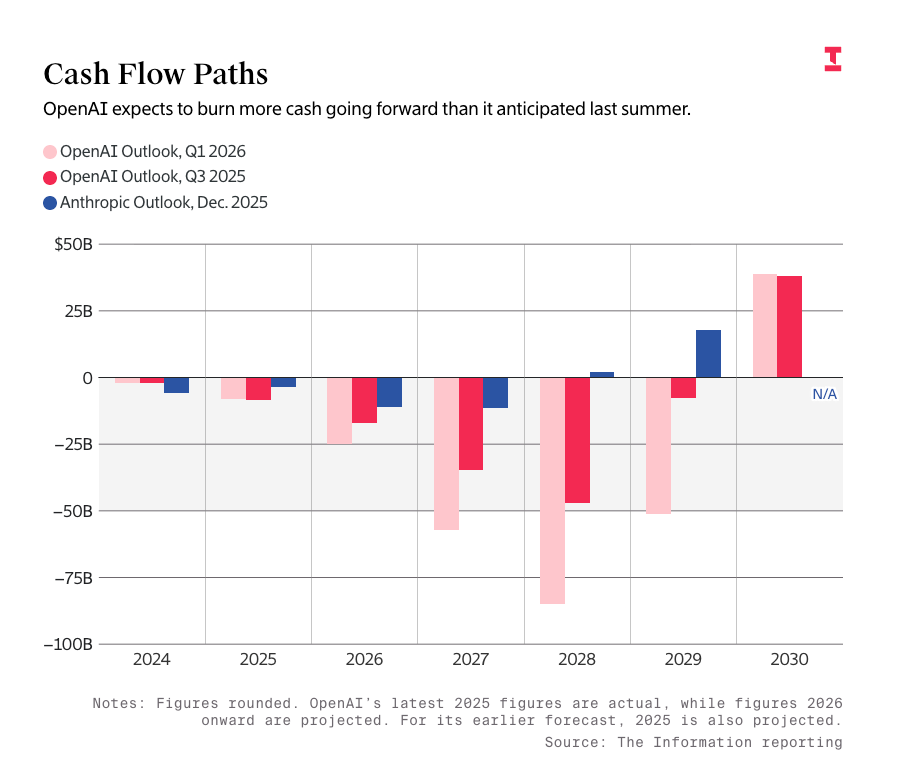
- It is unclear how it (or Anthropic) manages to do this. The Information reports estimates that OpenAI will go from negative $51 billion in free cash flow in 2029 to positive $39 billion in 2030. I’ll share the chart below.
- For OpenAI to actually survive, it will have to raise between $100 billion and $200 billion basically every year until then.
- For OpenAI to go public, it will need to have numbers that are competitive — both in revenues and losses — with Anthropic, a company with significantly-faster growth and a larger enterprise customer base.
For any of these things to happen, OpenAI will have to grow at a staggering pace, and effectively (per The Information’s reported projections) 10x its revenue between now and the end of 2030.
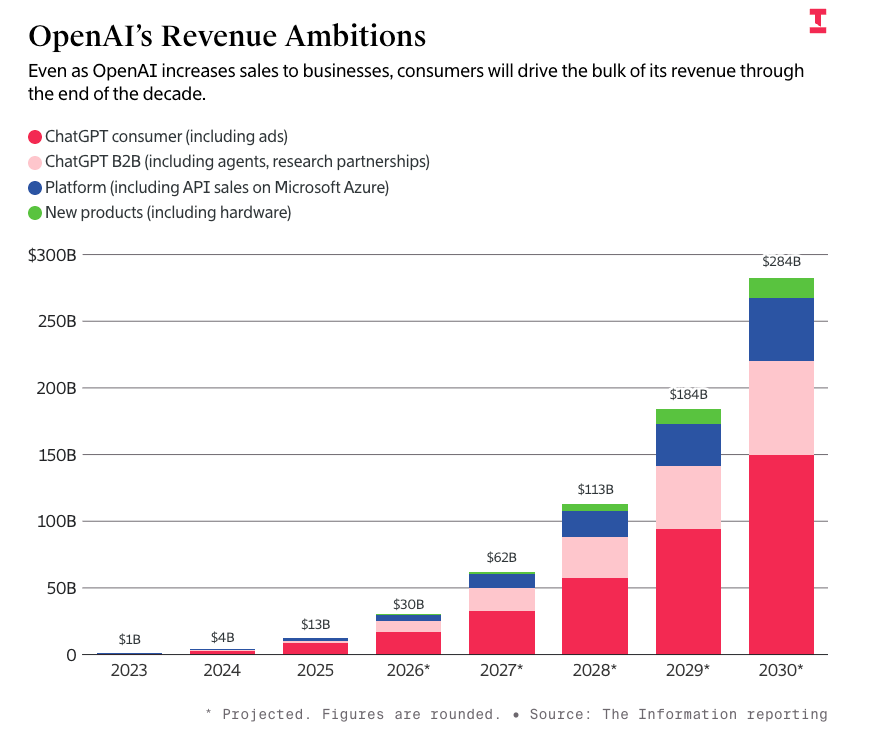
OpenAI’s projections have it near-tripling its 2025 revenues, doubling its 2026 revenues, nearly doubling its 2027 revenues, growing its 2028 revenues by 68%, and then growing its 2029 revenues by 64%. At the end of this magical mystery tour through revenue hallucinations, OpenAI will have it making more than NVIDIA did in Fiscal Year 2026 ($215.9 billion) and, somehow, becoming profitable:
I realize that many people have been conditioned by the tech industry to believe that every idea that a tech CEO has will always become reality, but the sheer scale of what OpenAI is both promising and obligated to do outpaces anything in modern history.
While much of what I’m saying is also true of Anthropic, (a company that itself has over $300 billion in commitments due in the next three years and is similarly-unprofitable) OpenAI has decidedly failed to play catchup at a time when enterprise customers see costs as a “huge issue,” which also makes it unlikely that (along with recent model price cuts) it will magically re-accelerate outside of allowing users to burn $14,000 a month in tokens for $200, which…also didn’t work well enough to get close.
In any case, any acceleration of revenues would also be an acceleration of costs, which will mean OpenAI will need several more $122 billion rounds from a dwindling pile of investor capital. SoftBank can quite literally not afford to invest anything further, with liquidity becoming so tight that it’s had to take out a $10 billion loan collateralized by its entire OpenAI holdings, with NVIDIA CEO Jensen Huang saying that its $30 billion investment from this year likely being its last. While various different venture capitalist paypigs may have some interest in funding it further, OpenAI will need more than it last asked for, without fail, every single year.
So, there’re really only two eventualities:
- OpenAI becomes the literal largest and most-successful company of all time.
- OpenAI runs out of money at some point.
This, again, is not me being a firebrand, but taking a relatively-clinical look at the hard numbers and asking how the fuck it affords it all.
And man, does a lot of shit have to go right.
OpenAI Has Over $800 Billion In Obligations Due By End of 2030, Accounting For An Estimated $146 Billion In Cloud Revenues For Oracle, Google, Amazon, and Microsoft Through The End of 2027
Per my last premium newsletter, OpenAI needs at least $800 billion to meet its commitments in the next three-and-a-half years, based on both the Wall Street Journal’s report on its projected $750 billion in compute spend through 2030 and an analysis of analyst notes on Broadcom, Microsoft, Google, Amazon, and CoreWeave.
The problem, however, is that much of this money will come due through the end of 2027, and require at least one more massive round of funding.
To get specific:
- I estimate that, based on analyst notes from Wells Fargo, that OpenAI is on the hook for around $87.5 billion in Broadcom chips across Fiscal Years 2027, 2028 and 2029.
- I have not included these in the total, because it’s unclear how much OpenAI is actually on the hook for. The Information reported a few months ago that both Broadcom and Microsoft would be financing the chips. It’s unclear whether OpenAI would be on the hook for ongoing payments as Anthropic is under its $35 billion, private-credit funded deal to buy Google TPUs and then rent them back from Google.
- Per analyst notes from Wells Fargo, UBS and Barclays, OpenAI alone is expected to account for over $126 billion of Google, Amazon and Microsoft’s cloud revenues in the next year-and-a-half.
- The reason for the odd year-and-a-half designation is that Microsoft’s Fiscal Year 2027 runs July 1 2026 through June 30 2027).
- This analysis also assumes that OpenAI will spend a linear $40.1 billion (per Wells Fargo estimates) on Microsoft Azure in Fiscal Years 2027 and 2028. In all likelihood, its deal and commitments will require it to spend more.
- This doesn’t count what OpenAI will need to pay CoreWeave as part of its five-year-long, $22.4 billion deal.
- Though the estimate is from December 2025, Michael Turrin of Wells Fargo estimates that OpenAI’s contribution to Oracle’s Fiscal Year 2027 (which just started on June 1 2026) will be around $10 billion, then rising to $39 billion in Fiscal Year 2028. I think a fair estimate here is to put this at around $20 billion.
Now, all of this is contingent on Google, Microsoft, Amazon and Oracle building enough capacity to capture that revenue, but if we assume that happens, OpenAI needs more than $147 billion just to handle its expected compute commitments through the end of 2027.
Here’re some other costs that aren’t included:
- Any and all costs associated with its still-theoretical $30 billion development in Georgia.
- Any and all costs associated with the launch of its consumer device.
- Salaries for its thousands of employees.
- The billions of dollars that OpenAI spends on data to train its models.
- Its compute costs with CoreWeave.
- Its compute costs with Cerebras ($20 billion over three years).
How Does OpenAI Raise More Funding?
With its IPO likely delayed — if it ever happens — until 2027, OpenAI will almost-certainly have to raise another round of funding by March 2027, likely at a similar scale to its $122 billion round from March of this year.
Who Would Invest?
The biggest problem that OpenAI has is that $110 billion of its last $122 billion round was made up of Amazon ($50 billion), NVIDIA ($30 billion), and SoftBank ($30 billion), leaving a mere $12 billion funded by a primordial soup of different venture capitalists, private credit funds, and public endowments that should have their executives fired, ideally into the sun.
In any case, $12 billion isn’t enough to cover a single quarter’s compute costs.
The point I’m making is that raising further rounds — before we get to any niggling problems about valuation — has already become near-impossible to do without the help of massive entities that are showing increasing signs of strain at exactly the moment OpenAI needs more money.
Let’s break it down.
As mentioned previously, SoftBank is running at the very edges of its liquidity, and owes another $10 billion due on October 1, 2026. While in theory it could sell more of its ARM stock to fund further rounds, said stock makes up effectively all of its Net Asset Value, and while further margin loans are possible, doing so would put genuine pressure on ARM’s stock price as, well, at some point you’re not just investing in a company but whether SoftBank might use its stock like a piggy bank.
A few weeks ago, Amazon sent the remaining $35 billion of its $50 billion investment as part of the larger round, and while it’s theoretically possible that it could invest more, its free cash flow has now gone negative, and it needs as much money as possible to meet its (agh!) projected $220 billion in 2026 capital expenditures.
Google is a potential investor, as I’m not sure people realize how big a Google Cloud customer OpenAI has become, with Stephen Ju of UBS estimating it will spend $9.375 billion in 2026 and $12.5 billion in 2027, and Google Cloud increasingly becoming Google’s largest growth vehicle. Then again, Google’s free cash flow also went negative in its latest quarterly earnings, and even the most braindead of investors are becoming a little nervous about how circular everything is looking.
NVIDIA could, in theory, afford to invest more, but the markets are even more nervous about its slow transformation into GE Capital. Jensen Huang is clearly aware of this, which is why his “backstop” of a “10GW” data center in Ohio (which OpenAI has signed a 20-year-long lease to rent) isn’t actually backstopping OpenAI’s compute spend, but the underlying assets in the event of a short sale:
For instance, if OpenAI were to walk away from the project, SB Energy would first try to lease the site to another customer for the same price, some of the people said. If SB Energy wasn’t able to find another suitable tenant, the firm would try to sell the site, and Nvidia would pay any difference in the value, up to $105 billion if the initial phase is completed.
By backing the asset value of the data center—not OpenAI’s ongoing lease payments—the structure limits Nvidia’s risk exposure substantially, those people familiar with the deal said. The chip giant’s guarantee covers completed data centers, not facilities under construction.
That’s a pretty big “if,” because it refers to 5GW of theoretical capacity built by a company that has never built a data center, at a time when the nearest equivalent — Stargate Abilene, at 1.2GW — is two years in and has only finished three out of eight of the buildings. Based on this description of the deal, NVIDIA only has to guarantee things in the event the data center is actually built.
As part of the deal, NVIDIA is investing $1.5 billion in SB Energy, a company invested in by both OpenAI and SoftBank that is trying to go public some time this year, likely as a means of adding further liquidity to SoftBank’s balance sheet, though the IPO would only raise, per Reuters, between $5 billion and $7 billion.
What About Private Credit?
OpenAI has already, across multiple funding rounds, raised from private credit funds from Blackstone, BlackRock, and Insight Partners, and it’s possible that these same funds could fuse together like Voltron as a means of keeping OpenAI alive.
That being said, we’re talking about over $100 billion a year for the foreseeable future, which is a little more than they could stomach on a private company with ultra-negative margins and a younger competitor currently eating its lunch.
Then there’s another problem: that private credit is already having trouble funding AI data centers, which are a (theoretically) far-more-stable investment in infrastructure and power. When NVIDIA announced its “$500 billion” fund, the media was quick to assume that it had already closed the money, rather than it actually being a “memorandum of understanding,” also known as “a non-binding agreement to maybe do something in the future.”
Yet a follow-up from Bloomberg found that it was even less than nothing, and that Jensen Huang had insisted on making the announcement despite months of slow progress:
Goldman Sachs Group Inc., Blackstone Inc. and Apollo Global Management Inc. had been working tirelessly for months to draw up debt deals that would help developers of artificial intelligence systems pay for chips from Nvidia Corp.
With slow progress on the complex deals, Nvidia’s chief executive officer, Jensen Huang, decided to change tack: He went public this week with the effort, saying the group is aiming to collectively finance AI computing deals totaling $500 billion — a round figure with no obvious provenance.
The reason I bring this up is that if private credit funds are having trouble funding data centers, they’re going to have a shit-ton of trouble convincing investors to pile into an unprofitable second-place AI lab run by a uniquely-unlikeable CEO who has a penchant for lying.
Could Venture Capital Step Up?
As mentioned earlier, OpenAI (and Anthropic) have scraped the bottom of the barrel of venture capital time and time again, and never managed to raise more than $30 billion at a time.
- $30 billion of OpenAI’s $40 billion 2025 funding round came from SoftBank.
- Anthropic’s $30 billion funding round from February 2026 involved an estimated $10 billion from NVIDIA and $5 billion from Microsoft, with the remaining $15 billion or so covered by thirty-seven different venture capital and private credit funds, including hedge fund Jane Street.
- Anthropic’s $65 billion funding round from May 2026 included $10 billion from Google and $5 billion from Amazon, as well as funding from Micron. Out of the 28 investors, only 8 were venture capital firms, with the rest made up of a mixture of hedge funds, asset managers, sovereign wealth funds and investment firms.
The sheer volume of names on these deals suggests that it’s genuinely very difficult to mobilize this much capital, and I think it’ll become difficult-to-impossible to do this every single year, even if Anthropic were to go public, as it’s very unlikely that the majority of these investors will actually be able to liquidate their holdings.
And remember, we’re talking about OpenAI here — stinky, expensive, second-place OpenAI, the one with all the obligations, the one with the CEO that wants to surveil everything his customers do. The one that has raised no more than $12 billion of funding from sources outside of NVIDIA, SoftBank, Microsoft or Amazon. That one.
There’re really two major problems:
- While venture capital might want to invest in OpenAI, actually mobilizing more than a few billion dollars is very difficult.
- OpenAI’s valuation is just too gosh darn high.
The Valuation Problem
OpenAI’s $122 billion funding round valued it at $852 billion.
And, per the New York Times, advisers pushed back on the idea of trying to go public at a $1 trillion valuation:
OpenAI’s advisers presented company executives with the option of waiting until 2027 to go public with a $1 trillion valuation, or lower the targeted valuation for a quicker I.P.O. Mr. Altman, said one person in contact with him on the topic, responded that any change to the trillion-dollar valuation was a nonstarter.
For some perspective, a $1 trillion valuation would be around a 15% premium, for a company that now accounts for 70% of Microsoft’s AI revenues and allegedly is the single-most-important startup since Google or Facebook.
Sorry, I’ll stop vagueposting: this is bad. For a company of this scale and importance, OpenAI should’ve waltzed into a $2 trillion valuation, except a public offering requires you to provide audited financial statements and an explanation of why your company is worth that much that goes a little further than an investor deck with annualized run rates and charts that promise the world.
The problem here is that if OpenAI can’t go public at even a trillion dollar valuation, it’s unclear why anyone would invest at $865 billion, or $800 billion, or even $700 billion, unless they happened to believe that it would go public at less than a trillion then magically become worth trillions more, somehow. The ability for any investor at this point to make a significant return is very, very small, made smaller by the fact that Anthropic appears to actually be meeting with investors for an IPO and is showing revenue growth…
…except even then, AI bulls are nervous, because $65 billion in annualized revenue (at the end of July) was lower than some forecasts, with market intelligence firm Yipit claiming it had hit $74.3 billion on July 22, causing confusing feelings in the minds and bowels of boosters that had expectations set by, I imagine, a combination of black magic and black mold.
While Anthropic CFO Krishna Rao has not been discussing valuations at early IPO meetings, investors and analysts are either expecting or wishcasting that it hits a $2 trillion valuation, though if OpenAI can’t get a trillion, it’s hard to see how Anthropic — a business of larger-yet-comparable size and equally-rotten economics — would somehow double that and, I assume, then some.
Seeing all of this, why would any venture capitalist with a working brain still invest in OpenAI at anything close to an $865 billion valuation? While current investors might follow on as a means of keeping the company afloat, at some point their limited partners might ask reasonable questions like “how do you intend to make us money?”
This is a problem already hitting Thrive, which has invested billions in OpenAI. Per Bloomberg:
The firm’s 2022 growth-stage fund — which includes Wiz, a business sold to Alphabet Inc.’s Google earlier this year — has returned 0.3 times the initial money it invested. That places it above the top 5% of funds. Most venture funds take between 10 to 12 years to return capital.
Thrive’s largest investment, OpenAI, is expected to generate a meaningful return. The firm was an early backer, investing in the startup through at least five separate funds going back to Thrive’s $408 million vehicle from 2018 and a fund that closed this year, a $6.23 billion instrument. Other notable IPO contenders within Thrive’s portfolio include Stripe and Anduril.
That’s right folks, if you invested in Thrive’s 2022 growth-stage fund, you’ve made 30 cents on the dollar, with much of it tied up in OpenAI.
While I’m not denying it’s possible, limited partners have their limits — especially as funds from Sequoia and other venture capital firms underperform the S&P 500.
And, not to repeat myself too much, OpenAI needs so much more money! It needs at least $100 billion a year, or it’s toast!
OpenAI Is Running Out Of Time (And Money)
The collapse of OpenAI would likely be a result of the walls closing in around its ruinous obligations and economics, with counterparties left short-changed and deals broken as things begin to unravel.
It starts, as obvious as it sounds, with OpenAI running short on funds, and we’ve already seen one sign that had happened with Amazon “completing” its $50 billion investment in the company a few weeks ago by sending another $35 billion.
To be explicit, that $35 billion was rumored to be contingent on OpenAI either going public or reaching AGI, though all that was said in the funding announcement was that it was contingent on “certain conditions being met.”
Nevertheless, Amazon didn’t decide to send $35 billion out of the goodness of its heart, or because it thought OpenAI was such a wonderful company — if I had to guess, it’s because OpenAI needed that money to pay for its compute costs, an estimated $9 billion of which flow through Amazon Web Services.
The fact that OpenAI needed $35 billion mere months after receiving at least $40 billion (and barely a month after getting another $10 billion from SoftBank) suggests that either compute pre-payment costs are brutal or OpenAI is absolutely annihilating cash at a rate unforeseen in the history of capitalism.
Whatever the reason, OpenAI clearly needs tens of billions of dollars every few months to keep up with its costs, and will only need more money as it “grows” — by which I mean has to pre-pay for compute costs for Amazon, Google, Microsoft, CoreWeave, Oracle, and Cerebras.
While it’s foolhardy to say when OpenAI might collapse (don’t I know it!) its collapse will come from the most obvious place — when it’s required to pony up a bunch of money without a means of raising more funding.
When you take a step back, OpenAI has had to raise funding near-perpetually since its $6.6 billion round closed in October 2024 on top of a $4.4 billion credit facility. On December 27 2024, OpenAI would say in a blog post that it needed “more capital than it imagined,” and would begin talks a mere month later in January 2025 to raise another round of $40 billion that would “close” on March 31 2025, though it would only raise $10 billion at first from SoftBank (with $2.5 billion of that from a syndicated group of investors).
Five months later in August 2025, OpenAI would raise another $8.3 billion “as part of” the round from a group of venture capitalists and asset managers, sell another $6.6 billion of internally-held shares to investors in October 2025, and by the middle of December 2025 was already rumoured to be raising another $100 billion, just before getting another $22.5 billion from SoftBank on December 31 2025.
While we know OpenAI ended 2025 with about $25 billion in cash, The Information was able to update us that it had around $73 billion in cash and “marketable securities” at the end of Q1 2026, which likely includes at least $35 billion from Amazon, NVIDIA and SoftBank, though for whatever reason the reporter refused to break out the cash part. Nevertheless, this means that OpenAI’s actual cash position looked better only by virtue of an influx of capital, and whatever happened to the company in Q2 2026 meant it needed another $45 billion (Amazon plus SoftBank, and maybe another $10 billion from NVIDIA, as it’s unclear how that whole thing was amortized).
What I’m getting at is that at some point in the next three months, OpenAI is going to need more money, likely tens of billions of dollars, especially as it enters new fiscal years for Google, Amazon, and CoreWeave, all three of which will likely require up-front payments for capacity that OpenAI does not have.
And, as I’ve repeatedly said, OpenAI needs to keep raising money because its costs increase with its revenues, and it has no clear path to either reducing them or increasing prices, as it found when it (and Anthropic) moved enterprise customers onto accounts that required them to pay the actual cost of their AI services.
None of this has much to do with my feelings about AI, and far more to do with basic mathematics. OpenAI has no economies of scale, it’s horribly-unprofitable, and does not have a stable business. This naturally means that it has to continually raise capital, except raising further capital is going to be difficult, based on the sheer amounts it needs, the dwindling funds available for it to raise, its already-inflated valuation, and the fact that it’s way behind a competitor facing exactly the same problems.
OpenAI has promised the impossible, and built a company that only makes sense if you’re willing to ignore the worst economics in the history of capitalism. Its future is dependent on raising over a hundred billion dollars a year in one of the worst funding climates in history. Its revenues are slowing, its competitor (and there’s really only one) has outpaced it (all while slowing itself), and its CEO is one of the single-worst spokespeople in history.
However you may feel, it’s impossible to argue with the logic that OpenAI is going to need more money by the end of the year — likely tens of billions of dollars — and that money will have to come from somewhere. It could be from Google, or Amazon, or even Meta. It could be from SpaceX, though Musk would have to hold his nose a little. It could be from Microsoft. It could be from a last gasp telethon of venture capitalists coming together to prop it up one last time.
But it’s gotta come from somewhere.
And at some point, OpenAI will simply not be able to pay its bills, or more precisely, it will have to hand over money to somebody who will not accept equity or IOUs in return.
Whoever it is that refuses that deal will be the one that pulls the trigger, and sends OpenAI’s body to the glue factory.
What Would OpenAI’s Death Look Like?
Sidenote: I want to be clear that this is all speculation. The world is chaotic, the future is uncertain, etc.
So, as much as I have talked about OpenAI’s death, its apocalypse could arrive in many different forms, but likely starts (as I just said) with it someone asking OpenAI for some real, non-circular dollars, only for Sam Altman to look at them like this:

But the first place to look for the end is OpenAI’s revenue growth. To compete with Anthropic, it will have to hit $60 billion in annualized revenue (I’m so fucking tired of annualized revenues) within the next three months. The first domino to fall will be them either missing this target or seeing revenues regress — if they haven’t already done so, of course, given that OpenAI measures run rate based entirely on a hand-selected four-week-long period.
All that it takes is a little stank of regression for the market to get nervous.
It’s inevitable, at this point, that both Anthropic and OpenAI’s revenue growth slows, if only because both of them have only got this far through a combination of subsidized subscriptions and companies burning millions on token-maxxing initiatives that will have petered out by the end of the year. OpenAI has spent a little over a year trying to play catch-up on the enterprise — a strategy led by now-departed COO Brad Lightcap — only to find that customers are becoming cost-conscious at exactly the time they need to be spending more. To make matters worse, Ramp found that customers have been slow to adopt Anthropic’s more-expensive “Fable” model because of the price, meaning there’s effectively no way to jack up prices.
I imagine Anthropic’s interest in bumrushing for a September IPO is an attempt to avoid investors seeing post-tokenmaxxing deceleration. In doing so, it’ll put OpenAI in a brutal position of having to defend itself against both its own and Anthropic’s economics at the same time.
So, the thing to watch out for is any sign of deceleration, which could mean outright “run rates have dropped,” to lower burn on OpenRouter, to more price cuts, to any kind of attempts by OpenAI to offer discounted tokens if bought in bulk.
Then, at some point, the money will stop flowing to somebody.
The problem about guessing who that might be is how much of the AI bubble is held up by OpenAI’s revenues. Microsoft, Google, and Amazon all have vested interests — literally and figuratively — in at least appearing to get paid by OpenAI, which means they’re likely work with it on deferred payments and/or equity shares in trade, likely instituting some sort of bastardization of the already-problematic “payment-in-kind” system used by private credit when it can’t afford it loans.
CoreWeave could be a place to look, with its largest customers being Microsoft (for OpenAI), OpenAI, NVIDIA, Google (for OpenAI), and Anthropic. While Microsoft and Google are unlikely to stop paying their bills due to OpenAI lacking the cash, OpenAI is allowed to pay its bills Net 360, meaning that if CoreWeave’s cashflow suddenly starts sagging despite revenues growing, it’s potentially because of Sam Altman stapling IOUs to Michael Intrator’s car along with a note that says “I’m sorry. I can’t. Don’t hate me.”
Cerebras — which gets somewhere between 50% and 70% of its revenues from its OpenAI contract — would be another place to look. If revenues (or cashflows) fail to materialize, it could be another sign that OpenAI is unable to pay its bills.
Other obvious signs would involve changes in guidance across any major hyperscaler, especially Oracle, Microsoft, Google or Amazon — specifically language suggesting that OpenAI’s revenue either isn’t real or isn’t arriving.
I also, to be clear, expect some sort of fundraising, likely heavily-funded by asset managers, with the potential for NVIDIA to break its pledge and invest again as a means of keeping the party going. Despite OpenAI’s lousy financial condition, its existence is critical to the entire AI industry, representing the majority of compute demand across effectively every provider, which will mean everybody will probably try and chuck a few dollars its way.
This could take the form of a suicide round (valuing it at or above the $965 billion valuation from Anthropic’s Series G round) or a brutal downround of around $800 billion, justified as ‘technically higher’ than the $730 billion pre-money valuation it got when NVIDIA, Amazon and SoftBank last invested.
I could also see it taking a doomed run at a public offering — especially if Altman somehow pushes out CFO Sarah Friar, who had previously said it wasn’t ready for IPO and got rewarded for her honesty by being made to report to “CEO of Applications” Fiji Simo, who left the company in July due to medical issues but for whatever reason remains active behind the scenes, per the FT.
Going public is a terrible, awful decision, which is why I’m increasingly-confident that Altman would consider it, especially if there’s demand for liquidity from investors. OpenAI, despite its prominent in the industry and load-bearing compute spend, is in a desperate and untenable position made worse by a competitor that worked out how to swindle enterprise customers that don’t know how to measure their token spend at a much-larger scale, and without something completely-unexpected, it’s unclear how it pulls itself out.
When things get rough, expect Altman to make comments about the challenges of building the future, criticizing those who are “endlessly negative” about AI and set "unrealistic expectations” from a man who said that OpenAI is close to creating a genie that can grant any wish. He will blame everybody — critics, the financial markets, journalists, ex-employees, Elon Musk, Dario Amodei, counterparties that “don’t understand what innovation demands,” venture capitalists, Twitter posters, and basically anybody other than Sam Altman, the guy who made hundreds of billions of dollars’ worth of commitments to the largest companies in the world with little or no plan as to how he might do so.
Sidenote: I am not engaging with stuff about government bailouts or nationalization, because I think both are intellectual crutches that exist to avoid thinking about truly chaotic events. OpenAI may get a government lifeline, it may get the ability to raise a loan from the government, or Trump may do absolutely nothing, as midterms are coming up and his approval rating is in the shitter.
No, these data centers are not all part of some big, secret surveillance state. No, there is not some mysterious $150 billion bailout. Every time you choose to believe this you are attempting to side with the wealthy, assuming they all have some brilliant plan they’ve formed with their magnificent brains, when in reality they’re all obsessed with growth and thought AI was the next big growth thing. Reality is far more depressing — the rich and powerful are as stupid (or stupider) than a regular person, they just got lucky.
OpenAI’s actual death could take a few forms, each of them fairly destructive.
Microsoft Absorbs OpenAI
In the event this happened, Microsoft’s first move would be to cancel effectively all cloud contracts that OpenAI has, and have to restate guidance to remove the $250 billion in “incremental Azure spend” it promised. There isn’t a chance in Hell that Satya (if he’s allowed to stay) is going to give Google, Oracle or Amazon hundreds of billions of dollars, even if it means taking massive impairments on GPUs.
In this scenario, Microsoft would potentially strip back (or entirely eliminate) the free ChatGPT product, and likely either tighten rate limits or move everybody on a ChatGPT Plus or Pro subscription to token-based billing, much as it did with GitHub Copilot in June.
OpenAI Is Allowed To Die, And Altman Becomes The Sacrificial Lamb For The AI Bubble
While I imagine some rescue package is pulled together, OpenAI could simply be allowed to run out of money, short-changing nearly a trillion dollars’ worth of compute contracts, killing CoreWeave, Cerebras, and anyone else reliant on its income. Its customers would be given API keys that flow to Microsoft AI Foundry, Amazon Bedrock and Google Vertex, and be told that there would be little or no further development or training of OpenAI’s models.
This situation, while obviously destructive for the entire industry, would give everybody a scapegoat. Who made all the promises? Sam Altman. Who ran a shitty company into the ground? Sam Altman. Who misled everyone into believing that there’d be infinite demand for compute? Sam Altman. Stories will leak that OpenAI was “not consistently candid” with its financial condition with partners, allowing everybody to reframe a trillion-plus dollars in waste as the result of one egregious con artist.
To be clear, the person to blame is Satya Nadella. He’s the one that made the initial investment, bought all the GPUs, and then kept buying them the second that ChatGPT took off. He’s the one that’s misled investors about the concentration of Microsoft’s AI revenue. If there’s an opportunity for him to lump all of the blame on Altman, he’ll take it, as will Jensen Huang, Andy Jassy, and Sundar Pichai, even if he’s relatively quiet about OpenAI’s billions in contributions to Google Cloud.
At 70% of Microsoft’s AI revenues largely from its tens of billions of dollars’ worth of compute spend, OpenAI will represent a material drop in hyperscaler revenues, and somebody will have to be blamed. It won’t matter that Anthropic is just as unprofitable or made hundreds of billions of dollars’ worth of promises it also can’t keep. OpenAI will make a fitting punching bag, a well-deserved one.
Anthropic and OpenAI Merge
I know, I know. Sam and Dario won’t even hold hands at an event. They hate each other. They both are vacuous psuedo-intellectuals desperate for attention.
Yet in a moment of desperation, OpenAI could turn to Anthropic for a lifeline — a choice merger that would pump both of their bags, all while allowing Altman and his cronies to escape blame. The united entity would likely be worth over $2 trillion, if only because of its combined customer base and theoretical “reach,” even if thinking about that for even a second makes it sound so unfathomably stupid, as said “reach” would come with multiplicative financial issues stemming from OpenAI’s lousy economics meshing with the equally-crap numbers underlying Anthropic.
That being said, in a desperate moment, this unity could also justify further investment from hyperscalers, venture capitalists and asset managers, giving them all something to point money at and say “this is the future of computing.”
I think it’s very unlikely this happens, and if it does, it would be ruinous for everybody involved. Neither of these companies make any kind of economic sense to anyone outside of the recently-concussed and AI boosters with dichromatic vision. Combining them would only create a much larger, uglier problem — one that would carry with it the very same problems that both companies have, compounded by the expectation that it would become the literal savior of the entire tech industry.
OpenAI’s Future Relies On The Impossible
The following is an objective list of what OpenAI has to do by 2030:
- Reach $284 billion in annual revenue.
- Pay $800 billion or more in compute obligations.
- In doing so, OpenAI must become one of the largest customers of Amazon Web Services, Microsoft Azure and Google Cloud, all at the same time, and continue to grow its spend.
- Become profitable.
- OpenAI lost $20.9 billion in 2025.
- If you are going to look at this and say “actually it didn’t” because of its Enrontastic accounting treatment, I also need to warn you — that identical guy in the bathroom is actually a thing called a “mirror,” a reflective surface that is showing you a reflection of you, not another person who is dressed like you and copies everything you do. I can’t imagine how scared you’ve been, and hope this has helped.
- As of Q1 2026, it has a non-GAAP operating margin of negative 122%.
- OpenAI lost $20.9 billion in 2025.
OpenAI is currently “approaching” $40 billion in annualized revenue, at precisely the time it needs to be accelerating. This company needs to leave 2026 at somewhere in the region of $75 billion in annualized revenue to have even a snowball’s chance of paying its ridiculous compute costs, and even then I’m not sure how it possible keeps up with the (at least) $146 billion in compute bills it’s got coming up.
It’s time for everybody to start having a real, meaningful conversation about what happens if OpenAI dies. This company has remained economically unstable since I started writing about it in November 2023, and while I might have underestimated its staying power, nothing has changed about my larger thesis that this company is headed for perdition, leaving its counterparties unpaid and alone with the consequences to follow.
Said consequences, as I outlined in the OpenAI Bubble, are very, very serious, representing an existential threat to SoftBank, one of the largest companies on the Japanese stock market, and its collapse will guarantee massive changes to the guidance of some of the largest companies in the world. There is a very real scenario in which nobody left with OpenAI stock is able to reach a liquidity event, which means the tens of billions of dollars of venture capital will remain unlocked and zeroed out unless it can go public, which is increasingly-unlikely.
It is no longer rational or reasonable to avoid discussing what happens if OpenAI dies. It’s a situation that should be on the mind of every journalist, analyst and investor, even if they don’t think it’s certain, because OpenAI is both horrendously unprofitable and has made commitments so significant that they now represent at least 20% of hyperscaler cloud revenues in the coming years, if not more like 30% to 40%.
It is actively irresponsible to ignore this situation any longer, and I encourage my peers, analysts, journalists, economists and investors to start seriously considering the likelihood and ramifications of the death of OpenAI.
For me to be wrong, in the space of three years OpenAI will have to become a company with annual revenues higher than Meta ($200 billion, versus projections of $284 billion in revenue in 2030) and meet obligations ($800 billion+) 27% larger than the combined revenues of NVIDIA ($215.9 billion), TSMC ($122 billion) and Samsung ($270 billion).
OpenAI doesn’t have to be illegal to be dangerous. Every time consent is manufactured for the astonishing waste and unrealistic promises of Sam Altman, companies further leverage themselves in an attempt to capture its theoretical value, and investors are further manipulated into supporting an industry almost-entirely founded on its compute spend.
As I discussed in the OpenAI Bubble, its collapse will have now-unavoidable economic consequences. The death of SoftBank is a very real possibility. The likelihood of the vast majority of AI investments going to zero is much, much higher than anyone wants to think about, at a time when, per Bloomberg, a venture capital firm that returns thirty centers on the dollar is considered an above-top-five performer. Oracle will collapse without OpenAI’s revenue.
To not actively and meaningfully discuss the potential for OpenAI to collapse is actively irresponsible. To act like there are not significant, existential problems with this company’s economics is to intentionally avoid reality, and whoever is on the receiving end of said ignorance deserves better, be they an investor reading your analyst note or a reader burdened with incomplete journalism.
What follows may be an Enron-Lehman Brothers hybrid, one that leaves unbelievable destruction in its wake, an avoidable systemic risk empowered and enabled by a kneecapped media industry and sell-side analysts incapable of seeing further than two quarters in the future.
In the end, there is no avoiding the damage that OpenAI’s collapse will create. The time to do that was in 2024, before it made all those commitments, and raised so much more money. Once it did so, it led the entire industry to believe that there was significant demand for AI, when all that was happening was Sam Altman and Dario Amodei were taking up every ounce of compute capacity, paid for with equity investments from the companies they bought it from, an illusion created by men driven mad by their desperation for hypergrowth.
However you feel about my work, I am begging you to take even the prospect of OpenAI’s collapse seriously, and prepare accordingly.
If you liked this piece, you should subscribe to my premium newsletter. It’s $70 a year, $17 a quarter, or $7 a month, and in return you get a weekly newsletter that’s usually anywhere from 10,000 to 18,000 words and provides vast, detailed analyses of the biggest events and companies in the AI bubble.
If you want to get in touch — and especially if you have any juicy information about Anthropic, OpenAI, or any other companies in the AI bubble — hit me up on Signal at ezitron.76. I’m also on IB on The Terminal.