
If you liked this piece, you should subscribe to my premium newsletter, and you can subscribe on the following links: $70 a year, $18 a quarter, or $7 a month.
In return you get a weekly premium newsletter including vast, detailed analyses of NVIDIA, Anthropic and OpenAI’s finances, and the AI bubble writ large. It's a great way to support my free work, and you'll get full access to my massive archive of premium analyses of the tech and finance industry. I just did a two part Hater's Guide To AI Debt that's essential reading given the current climate around AI data center loans.
On Friday, I’ll dive into the world of junk debt – or, what happens when a hyperscaler's credit rating slips into the abyss, or what might happen as a certain money-losing AI lab moves into the world of junk, building on the story I'll tell today.
If you want to get in touch — and especially if you have any juicy information about Anthropic, OpenAI, or any other companies in the AI bubble — hit me up on Signal at ezitron.76. I’m also on IB on your Bloomberg Terminal.
Every day somebody asks me when or how the AI bubble will burst, what might cause it, what potential avenues I’m missing, begging, pleading for some sort of hole in the argument outside of “but what if all the bad things don’t happen and the good things are even better than we imagined?”
These questions come from everyone ranging from random internet people to hedge fund managers on my Terminal trying to squeeze me for free research, and every one carries with it some thin vein of wrongheaded hope — that there’s some subtle failure in my arguments and, in turn, some way in which this all turns out okay.
Even those actively agreeing with me hesitate to follow my arguments through to their logical endpoint, mostly because doing so can make you feel a little queasy. If you actually sit and think about the consequences of what’s happening rather than just a collection of different events organized in a row that you have to remember to speak about on a podcast, it’s easy to say stuff like “Anthropic has $413 billion in non-cancellable compute contracts” or “$18 billion in Oracle data center debt is trading at 84 cents on the dollar” without ever really thinking about what any of that means.
Everyone acts as if everything in the AI boom is going to go fine, all without much consideration of the real world and its consequences for the greater tech industry. They assume that OpenAI and Anthropic will go public, grow forever, raise whatever debt they need, and that every single data center investment will work out fine.
And make no mistake, these companies will need at least $50 billion or more in debt every single year, all with what will likely be low-grade junk credit ratings.
It’s time to talk about why that’s very, very unlikely.
10 Year Treasuries Hit 5.3+% And Keep Selling Off, Making Any And All AI Debt More Expensive
Who This Effects: Every Single Data Center Company, SoftBank, Anthropic, OpenAI, SpaceX, Google, Amazon, Meta
Alright kids, let’s talk about debt. Some of you are big, strong, and smart and already know this, but some of you don’t, so we’re going to all learn or re-learn together.
I apologize in advance for having to go through all of this, but trust me, you want to know.
Every month, the US Treasury (the part of the US government that manages the country’s money) has an auction for ten-year-dated Treasury Notes, typically referred to as “Ten Year Treasuries.” These auctions then receive bids. Regular people offer something called “non-competitive bids,” meaning they’ll say how much money they want to lend the government, and then there are competitive bids where financial institutions say “we’ll buy in at this specific interest rate.” The US government borrows over other time periods too, but that’s not important for today.
US government bonds are, in general, considered “risk free,” as they’re backed by the full faith and credit of the American government. This status makes them the base for all lending, because anyone borrowing money has to compete with what the US government (or another government) offers to pay.
You’re paid your interest, in the case of the ten-year bill, every six months, with the principal repaid when the bond matures.
Sidenote: “risk-free” in this case is from the perspective of an investor who has to choose between being paid by the government and a riskier investment like lending money to a company. Although both are unlikely, the odds of the US government deliberately defaulting on its bonds is far smaller than even the most iron-clad of companies.
Ten-year treasuries are considered the “benchmark” rate, because it’s the most actively-traded and liquid security in the world, and while mortgages in the US tend to be structured as thirty-year-long loans, most people tend to either sell or refinance their houses in the first ten years of the loan. It also represents, to paraphrase a friend in fixed-income, a period of time that’s both a long way away but not so long as to be impossible to comprehend.
You’ll also notice that the “pricing” of treasuries (and bonds in general) is usually expressed in percentages rather than prices. That’s because the price of a bond doesn’t tell you how much it’ll pay you, how many payments there are left to go, or what its value is relative to other bonds.
As a result, the pricing page for ten-year-dated US Treasury notes shows an interest rate — 5.33%, for example — that represents “how much money would I get on an annual basis if I invested in ten-year Treasuries today?” based on the soup of different notes in the market based on their various maturities and interest rates.
The ten-year is considered the barometer of investor sentiment — how much the market feels comfortable lending to the US government, based on everything they do and do not know, which is why it shifts so often with economic data and the price of oil.
And, importantly, when a bond “gets cheaper,” its effective interest rate goes up, because you’re paying less money for a debt instrument that pays a consistent amount.
Why Are Ten-Year Treasury Notes “Selling Off”?
Right now, ten-years are “selling off,” meaning that the effective interest rate on them is going up, based on a few different factors:
- The US government has over $40 trillion in debt, and to pay off that debt, the US government issues more debt, with interest payments making up 14% of all federal spending, and the federal deficit (IE: how much more the government spends than it pulls in in revenue) sitting around $2 trillion a year, meaning that, at minimum, it’ll need to borrow an additional $2 trillion in 2027 beyond what it borrowed in 2026 just to pay what Congress has authorized in spending, and the same amount again in 2028 if the deficit stays the same next year.
- This means that anyone pricing US Treasuries is doing so under the virtual guarantee that the US government will have to issue more debt.
- The alternative is that the US government cuts social security, medicaid or military spending, which would be very unpopular, and thus very unlikely to happen.
- The wars in Iran and Ukraine are putting increasing pressure on the world’s oil supplies, because higher fuel costs push up inflation because they increase the cost of effectively everything — both driving and flying to places, which is how most people and goods move around the world, as well as the cost of electricity (particularly where natural gas is concerned).
- As I wrote a couple of weeks back, the war in Iran has also cut the supply of other raw materials, including sulfur (which is used in fertilizers), helium, and aluminium, further exacerbating the inflation crisis.
- With the price of everything (at least in theory) inflating, investors demand that their bonds pay them at a rate that matches the rate of inflation.
- There’s an ongoing debate — discussed here by the Financial Times — about whether US data center debt issuance has reached a point when it’s creating meaningful competition for US government debt, specifically that issued by Google, Meta, and Amazon, because these “stable” companies are offering attractive rates that are, in the eyes of some investors, as stable as lending to the US government. While it’s had some effect, it isn’t the big reason that the ten-year is selling off.
So, while we can’t point at one reason, there are plenty of reasons that ten-years are selling off, which is in turn raising the cost of borrowing for literally everybody — consumers, hyperscalers and AI data center developers alike — in a way that’s distinctly difficult to calm down.
Sidenote: I’ve mentioned this before, but when you see treasuries measured in “bps,” that refers to basis points, or 0.01% measurements. This is because a move of even 6bps — or 0.06% — has a dramatic effect on global borrowing costs, considering the size of the global bond market.
That last part is very, very important. While stocks can recover based on good news (even if said good news is entirely fictional), the price of ten-year-dated treasuries is reacting to so many different economic indicators that even the things that should calm it down — like lower-than-expected jobs numbers — aren’t stopping them from dumping.
And so when the ten-years dump, the base interest rate of almost everything increases, and some of the things that are becoming more expensive as a result are actively contributing to the problem. The US Government cannot afford to stop issuing debt, the wars in Iran and Ukraine aren’t going anywhere, and hyperscalers expect to issue $400 billion in bonds in 2027 alone.
As a result, everything gets more expensive for everyone, and the worse your credit is, the worse this gets.
So, now that we know all that, we can speak to the larger problem. When somebody borrows money, they do so priced at a “spread” above the equivalent-dated US Treasuries — usually judged based on the underlying economic health of the company, the general vibe about the kind of thing they’re borrowing for, and the current ‘price’ (read: effective yield) of their debt, usually measured based on its “spread” from today’s US Treasury prices.
This means your borrowing prices can go up based on a few factors:
- The price of equivalent US treasuries at the time you are issuing the debt.
- The current price of the company’s debt.
So if your company — say, Oracle — has a bunch of bad press about its debt being distressed, the market will “price” more risk in, selling off the current debt and pricing it as if the effective yield was higher, setting a floor for how expensive your debt will be. This floor will also increase because the price of US treasuries is likely higher today than it was when you raised.
I’ll give you an example. As I discussed last week, Oracle’s $18 billion September bond sale would have (yes, the number has gone up) over $7 billion in added interest over the course of the bonds due to both the sell-off of Oracle’s debt and the overall Treasuries market.
At the time, ten-year-dated US Treasury notes were at a mere 4.13% — as mentioned above, a 0.06% increase is significant, so a 120 basis point difference is gigantic — but Oracle’s overall risk has also exploded along with them.
At the time, spreads were between 105bps and 165bps (so 1.05% to 1.65%) above US Treasuries. Today, those spreads range from 171bps to 282bps, a double dose of pain at a time when the market sentiment is that it doesn’t trust Oracle as much as it did in September — as in how much more it’s demanding over the benchmark rate offered by the government — has increased along with the cost of the benchmark itself.
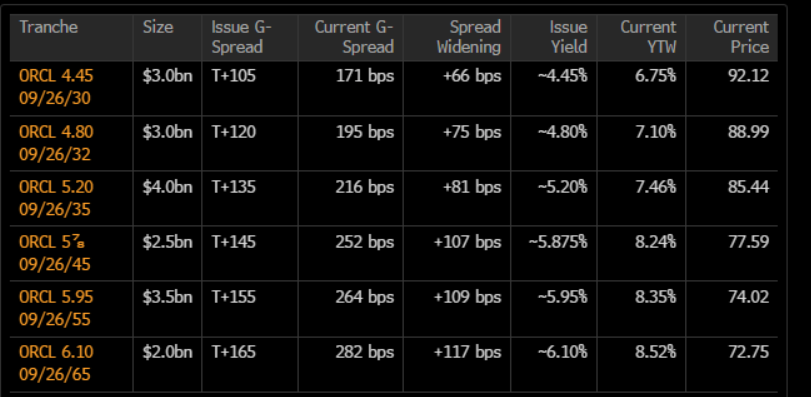
And so, while I’m not going to repeat everything I went over last week, the point I’m making is that anyone raising any AI-related debt is going to get shafted by both overall Treasury prices, sentiment around AI in general, and their own specific financial situation.
Yet Oracle is, at least for now, “investment grade,” which means that even though its debt “trades like junk” (IE: investors are asking for effective yields of anything around the high-yield index’s average of 8.2%), it’s in a much better position to borrow than the vast majority of AI data center SPVs or neoclouds like CoreWeave, which has Goatse-level spreads of 672bps to 882bps, with the effective yield on its shortest-dated debt (four years) sitting at 11.53% and its longest-dated (a mere six years) sitting at 13.49%.
There are, of course, ways around borrowing on your credit profile. For example, when CoreWeave opened an $8.5 billion delayed draw term loan facility in March 2026, it was able to get it rated as investment-grade and at SOFR (the percentage on overnight borrowing from the Fed for banks) plus 2.25%, all because the counterparty was Meta, and thus the underlying payments would be considered “safe.”
This may seem like the cheat code to get around all these horrifying rates, except CoreWeave, per analysts at UBS, needs to raise $102 billion in debt through 2030, which means it will have to keep raising on its own two feet.
Well, there’s a problem there.
The Biggest Data Center Investors Are Getting “More Selective” At Exactly The Wrong Time
Per The Information, “cracks are beginning to form” in the AI data center debt boom:
Bond markets are getting tough for lower-rated borrowers. One example: CleanSpark, which is developing a data center for Meta Platforms, had to offer investors big concessions to land financing earlier this month.
That deal is among the clearest signs yet that financing the data center boom is getting expensive across the board, and investors are getting picky about which new projects they’ll back. The bank loan market too is showing signs of strain, with some lenders like Société Générale, Sumitomo Mitsui Banking Corp. and Mitsubishi UFJ Financial Group becoming more selective in lending to data center projects, people arranging the deals say. Those dynamics mean companies could struggle to borrow for planned data centers, jeopardizing growth plans for the broader AI industry.
Long-term Zitronistas will remember when I brought up some of these names in my end-of-year-2025 piece The Enshittifinancial Crisis, with SMBC present in seven and MUFJ present in seventeen of the data center deals I analyzed, with one or both of them in effectively every Stargate and CoreWeave debt sale, and both involved in SoftBank’s $15 billion 2025 bridge loan.
“More selective” doesn’t necessarily mean “done investing,” but is more akin to the lights going on in a particularly-rowdy party and seeing who may or may not have pissed themselves. Data center debt is now pricing based on increasingly-sour sentiment driven by power delays, local pushback and a general anxiety that maybe these debts won’t actually get paid.
They also might realize that their due diligence was lacking when it came to building some of the most-ambitious infrastructure projects in history. Here’s an example of how deep the due diligence was for Blue Owl’s $10 billion investment in AI data center projects, per The Information:
Blue Owl’s willingness to make fast decisions has made it a favored partner for the developers racing to produce giant data centers. It took just 15 minutes for Blue Owl executives to agree to invest up to $10 billion in future projects alongside real estate firm Primary Digital Infrastructure during their first in-person meeting two years ago, said Primary chief investment officer Bill Stein.
In any case, AI data center debt is way more expensive now by virtue of the current state of treasuries, with costs compounded by the anxiety around them in general.
This means that any “virgin” projects — those that aren’t directly backstopped or co-signed by hyperscalers — are guaranteed to hit egregiously-high, 9% to 14% rates, which makes (as I discussed a few weeks ago in my two-part debt series) it near-impossible to make the already-questionable economics of running a data center work.
This means that any AI data center debt being raised right now is doing so under stricter credit conditions and doing so at unrealistic, unsustainable prices, if they’re going to be able to raise at all. This makes the $174 billion in debt that SB Energy needs to raise to fund its theoretical data center project with OpenAI — even when backstopped by NVIDIA — either horrendously expensive or impossible to complete, as does it mean that any future large, multi-gigawatt projects will add billions of dollars in interest payments to already-expensive debt.
This all makes pontifications that data center spending will increase to $32 trillion by 2050 equal parts stupid and wasteful, on top of the overall problem that there isn’t even enough demand right now for hyperscalers to break even on their 2026 and 2027 capex plans.
Yet data centers are buildings with stuff in them that, in theory, could be repossessed and leased to another party — or at least sold off — in the event of a default. Investors would theoretically get some sort of return (based on the seniority of their debt, but that’s not important right now) if CoreWeave died, or if Oracle’s Project Jupiter (the one connected to its “Force Majeure” notice) failed to secure power.
We’ve got another problem on the horizon, and nobody seems to be talking about it.
OpenAI and Anthropic Would Need At Least $50bn A Year In Debt Once It Goes Public, And It’s Unclear How They Raise It
Back in June, Anthropic President Daniela Amodei said the following at a conference:
"It's a very capital-intensive business to train AI models," Amodei said at the Bloomberg Tech conference in San Francisco. She added that the public market is "very well-suited to that."
Quick question, Daniela: are they?
Nobody seems to want to talk about what Anthropic’s plan is once it goes public as far as continuing to raise egregious amounts of capital. Once a public company, Anthropic will no longer be able to raise venture capital at its current scale (over $95 billion in 2026) alone, and if it intends to raise even half that much on a yearly basis, it will become one of the largest issuers of junk-grade debt in history.
In both AI labs’ cases, they are most-decidedly going to be priced like junk, even if the malignant scumbags are able to con ratings agencies into giving them investment-grade ratings, because while the bond markets listen to credit ratings, they price based on what the actual company looks like, guaranteeing Oracle-esque 8% minimum yields on whatever they issue.
The problem is that OpenAI and Anthropic don’t really have assets. They don’t own any of their data center infrastructure, the chips inside, or even their office buildings, and that’s before mentioning their negative cashflows and products under constant threat from cheaper open source alternatives.
This means there’s very little for the company to offer as collateral, and would be raising debt based on a theoretical break-even point somewhere in the future, one that they would both have to actually explain with a level of depth that neither of them have had to deal with.
The big difference between Anthropic/OpenAI and SpaceX is that the debt in question would be raised to fund company operations rather than capital expenditures, as training costs are not capex and at least based on OpenAI’s audited financials are considered operating expenses. While CoreWeave loses a bunch of money, those losses mostly come from the expensive debt it has to take on to fuel its capex ambitions and the depreciation of its GPUs, meaning that it has (if you remove its largest costs!) a positive EBITDA.
Sidenote: CoreWeave is still a massive stinker of a company!
This difference also likely precludes either company from raising capital via an SPV or other off-balance sheet funding, because those are collateralized using the underlying asset, such as Anthropic’s $161.2 billion in non-cancelable contracts to lease back Broadcom’s TPUs. Convertible bonds — low-interest bonds that can convert if a stock price is hit or, at maturity, allow investors to take stock or cash — are an option, but run the real risk that the stock is lower than when the bonds were issued, meaning that Anthropic or OpenAI would have to pony up a ton of cash.
The only exception would be an SPV tied to customer payments which I’ll get to in a bit.
At Negative EBITDA, Investment-Grade Is Near-Impossible, As Debt Markets Only Care About Real Numbers, Not Bullshit Like “EBTIT”
Yet things get a little messier when you factor in non-cancelable contracts, which total $413 billion in Anthropic’s case across the next seven to ten years, guaranteeing financial strain at a time when future cashflows are far from guaranteed. Take-or-pay agreements — the subprime mortgages of the AI bubble — are considered debt equivalents in the eyes of creditors, which would in turn drag on cashflows.
You see, you can jingle the keys of "annualized run rates” and “adjusted operating income” in the faces of venture capitalists and journalists as much as you want, but investors require actual cashflows, even within a frothy market. Anthropic’s vulgar “Earnings Before Training, Interest and Taxes” measurement does not matter when the entire calculation is made on cashflows, and any attempts to act otherwise are either ignorant or deceptive.
EBITDA, of course, refers to Earnings Before Interest, Depreciation and Amortization, which means that all “above the line” costs — such as inference costs, training costs, SG&A and leases — are counted, but the cost of depreciating assets like GPUs (of which Anthropic and OpenAI have none) and interest is left off.
Let me give you a very straightforward example from my own story on OpenAI’s audited 2025 financials, when it had $34 billion of expenses and $13.07 billion in losses, for an EBITDA of $20.92 billion, or an EBITDA margin of negative 160%.
At Negative EBITDA, Outside of Government or Hyperscale Guarantees, Anthropic and OpenAI Will Be Rated Junk (B- To CCC+)
At that EBITDA, it would immediately slam the door shut on an investment-grade rating for OpenAI or Anthropic, and likely get rated between a B (highly speculative) and a CCC+ (substantial credit risk). If ratings agencies push through at that grade, it means they are completely and utterly corrupt, and going against their own guidance about how credit ratings are provided. Every single metric underlying an investment grade rating comes from EBITDA, and SpaceX was only able to qualify through the success of Starlink as a profitable business.
S&P Global also penalizes revenue concentration — specifically referring to customers or products making up a large slice of revenue. In Anthropic and OpenAI’s case, they effectively have two products — the API and subscriptions — and nearly a quarter of Anthropic’s 2025 revenue came from two customers. While SpaceX is a shitty company, it’s a diversified one. OpenAI and Anthropic are not.
In any case, if either gets an investment-grade rating, it’s likely that a hyperscaler has stepped up and guaranteed some or all of the debt, but in doing so, they’d likely sacrifice part of their own credit rating in the process. The same might happen — as hinted at above above — through a rotten kind of SPV, where the hyperscaler guarantees a certain amount of contracted revenue to OpenAI, allowing a connected SPV to raise at an investment-grade interest rate.
Sidenote: Investment grade would allow them to open up much, much longer-rated debt. I’m honest that this happening would require a lot of people to ignore a lot of the very basic mechanisms used to rate and issue debt, which means I’d need some of the rationale behind it to even begin to estimate what might happen.
I’ll add that if this happens, it will be a catastrophic failure of regulation and ratings agencies at a level unseen in the equities markets.
If we assume that OpenAI or Anthropic gets a junk rating, it becomes entirely-unable to raise from the investment grade market, leaving it with dwindling options based on how junky that rating is. The problem they face there is that even the highest-rated level of junk (BB+) requires sustained cashflows, and even lower rungs like B+, B and B- need some sort of path to EBITDA positivity.
Each level of junk grade carries its own limits in both how much money they could raise based on their particular financial profile and the hard-and-fast rules of various funds investing in high yield debt.
When I say “CLO-eligible term loans,” I’m referring to collateralized loan obligation funds that scoop up large buckets of loans and resell them as one investment vehicle, buying somewhere between 60% and 75% of corporate loans. These CLOs also have their own rules about exposure to debt based on various factors, including industries and credit rating, and depending on where OpenAI or Anthropic fell, the demand for their loans — and secondary sales of their loans (because investors LOVE to resell debt!) deteriorate dramatically based on their rating.
The following assumes a $2 trillion valuation, which is far from a foregone conclusion.
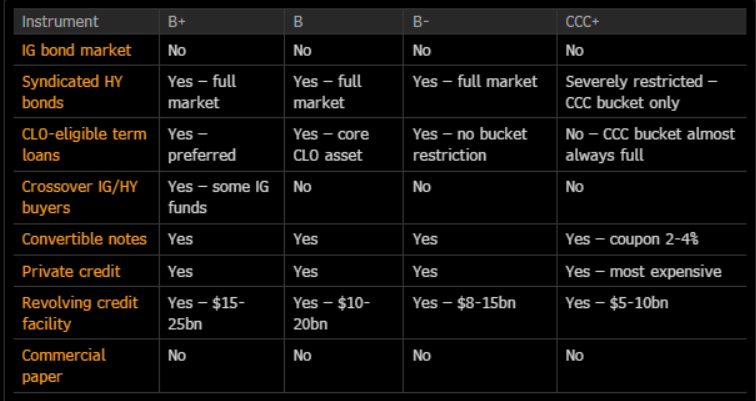
If we assume $50 billion is what they need on a yearly basis, this becomes increasingly difficult based on the credit rating.
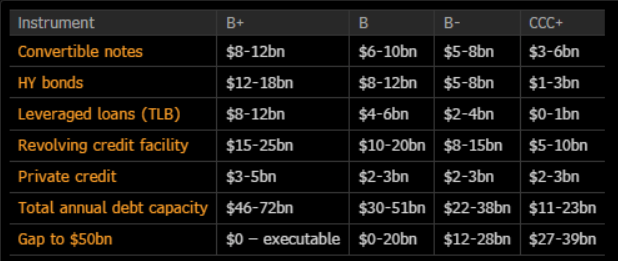
As you can see, debt alone isn’t getting these companies $50 billion a year outside of a rating that’s near-impossible outside of ratings agencies defaulting on their jobs.
Why Don’t They Just Do At-The-Market Sales?
In theory, at a $2 trillion valuation, both Anthropic and OpenAI could sell directly onto the market, but using this as a serious ongoing funding mechanism naturally depresses the price, though the scale of the float — as in how many shares were sold at the IPO.
At that valuation and a planned raise of $60 billion to $100 billion, Anthropic will have a very small float — around 5% — which would mean it was naturally capped on how many shares it could dump in a particular year. It’s hard to gauge this based on the unknowns of its trading volume, but if I had to guess, there’s maybe $20 billion in annual share sales it could do.
[Whiny Voice] But What About Uber And Amazon-
AhhhhhHHHH FINE YOU WANT TO TALK ABOUT UBER SO BADLY WE’RE GONNA TALK ABOUT UBER AND AMAZON AND TESLA!
- Amazon went public in May 1997, raised $54 million ($112 million adjusted for inflation), didn’t get a credit rating at the time (it didn’t issue corporate debt at the time), and had a negative 19% EBITDA margin. It was profitable four years later.
- Uber went public in May 2019, got a B+ Credit Rating, had an EBITDA of -$2.7 billion, and an EBITDA margin of negative 21%, taking its first EBITDA profitability in Q2 2023. It raised $8.1 billion at IPO ($10.6 billion in today’s money).
- By comparison, OpenAI’s EBITDA margin for 2025 was negative 160%.
I’ll add that both Anthropic and OpenAI want to raise $50 billion at IPO.
In other words, stop making these comparisons, they are not accurate.
Anthropic and OpenAI Should Not Be Allowed To Go Public, and Allowing Them To Do So Actively Harms Investors — And Their Obligations Require Them To Make Hundreds of Billions In Revenue
I realize I’ve gone through a lot of technical stuff so far, but the reality is pretty simple: Anthropic and OpenAI do not resemble the financial condition of any company I could find in the history of the stock market outside of WeWork. They are unprofitable, unsustainable, and the only conditions under which they could raise significant debt would involve catastrophic failures of regulatory and ratings bodies.
Sidenote: When WeWork tapped the bond markets in 2018, it received ratings of B (from S&P) and BB- (from Fitch). Both sit below the BBB- threshold for investment-grade debt.
And while WeWork resembles OpenAI and Anthropic, insofar as it didn’t actually own any of the workplaces it rented out to freelancers and startups, it differs in how much it wanted to borrow, seeking only $500m, and the fact that WeWork had a fairly diversified customer base, which is something that (as mentioned) credit ratings, but especially S&P, tend to look favorably on.
I’ll add that the only thing worse than allowing them to go public will be to allow them to raise debt at anything other than the junkiest levels that the market has to offer. These are not stable businesses, nor are they run with much regard for their underlying capital or employees. Both of them have massive amounts of concentration risk, unstable customers, brittle economics, own virtually no assets, and have demonstrated little to no ability to reduce their costs outside of questionable accounting that doesn’t change the fact that they cannot afford their bills.
As a result of their $1.3 trillion in compute commitments, neither company can become “capital efficient” by cutting their training costs, because said training costs are the only means of further growth outside of massive price increases that are unlikely to grow their businesses.
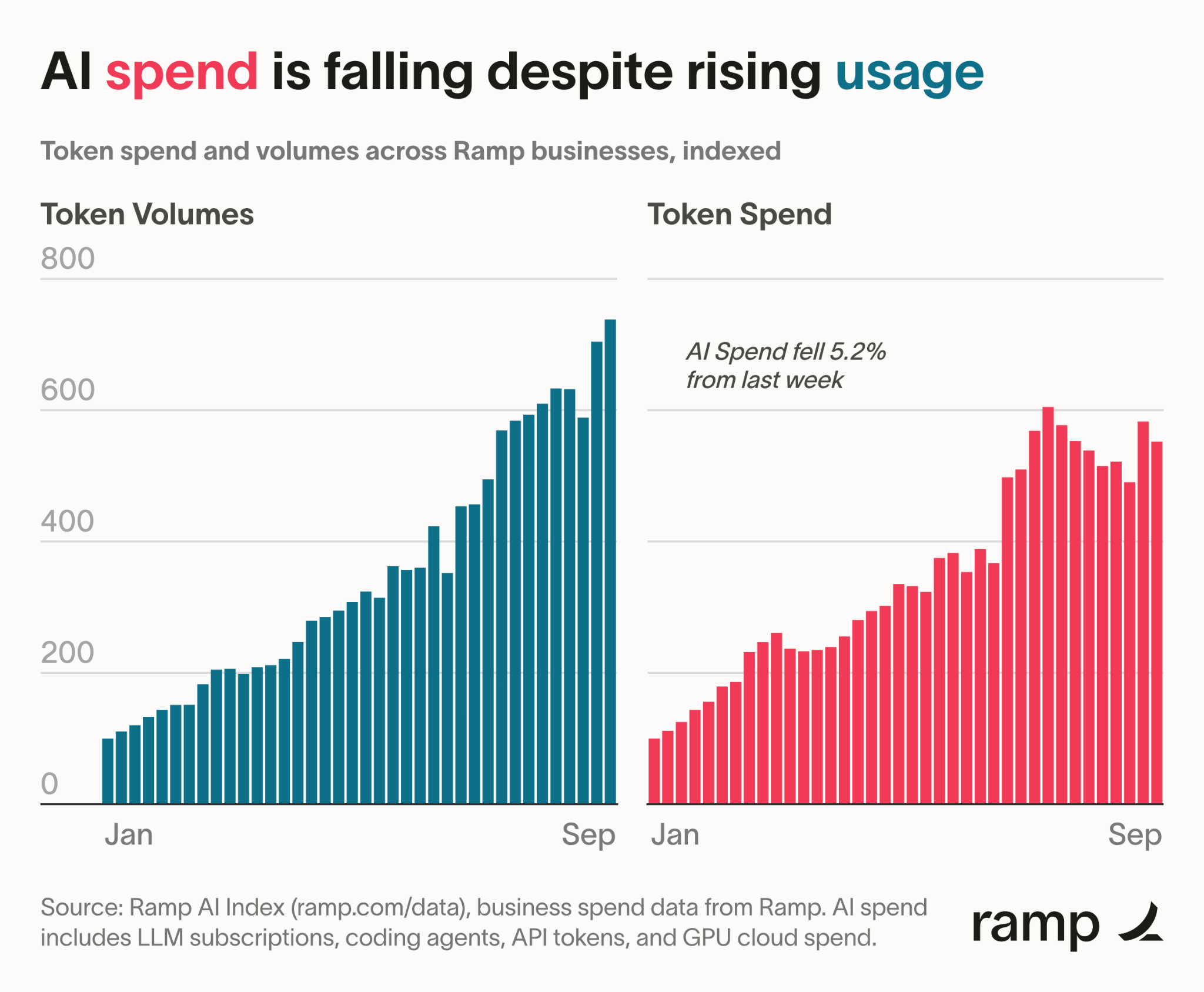
To make matters worse, both are cutting prices to compete with each other, and per Ramp, said price cuts aren’t increasing usage:
Neither company can afford to exist without near-infinite resources, and neither company can afford to slow down due to their massive compute commitments, which have become materially linked to the future growth trajectories of effectively every hyperscaler, as well as Broadcom, which — in pursuit of becoming NVIDIA — has added ruinous amounts of debt at the worst time in history to do so.
And that’s really the biggest problem here.
Nobody Wants To Talk About The Real Risks of the AI Bubble
While Anthropic and OpenAI are yet to pillory the debt markets, their counterparties — and those inspired by them — have been doing so for years with little or no return on investment.
As I discussed a few weeks ago, there are currently over $200 billion of NVIDIA GPUs sitting uninstalled in warehouses, with Morgan Stanley (as found by Bryce Elder of the FT) estimating that more than half of GPUs sold in 2026 through 2028 won’t have anywhere to plug in. Hundreds of billions of dollars have been spent on data center capex for effectively no reason, outside of the belief that there’s “insatiable demand for AI compute” when the reality is that more than 70% of all AI revenues — and I estimate more than 80% of all compute sales — are from Anthropic and OpenAI taking up whatever capacity comes online, leaving very little left for the rest of the world and creating the illusion of massive demand.
Both of these companies want to dump themselves onto the public markets, raise tens of billions of dollars of debt a year, and dump further shares onto unsuspecting investors based on unrealistic revenue projections of hundreds of billions of dollars a year by 2028. Both OpenAI and Anthropic are astonishingly bad businesses, losing $20.92 billion and $8 billion respectively in 2025. The best response that anyone has got to these shocking figures is to vaguely point to adjusted profitability numbers provided by companies that have constantly shared deceptive annualized run rate figures as a means of obfuscating their financial condition.
And these companies account for, per their own obligations, $1.3 trillion of future earnings across Microsoft, Google, SpaceX, Oracle, and Amazon, with $413 billion of Anthropic’s commitments being non-cancellable, and OpenAI projecting to spend at least $750 billion on compute through the end of 2030, with no answer as to how these companies afford to do so.
Analyst expectations have OpenAI and Anthropic contributing at least $444 billion in revenue across hyperscalers in the next three years, and if this revenue fails to arrive — either through insolvency or renegotiation of terms — every connected hyperscaler will see massive revenue misses. These are not hyperbolic, mean-hearted or “skeptical” claims, but the hard mathematics underlying an industry that so often convinces those supposedly analyzing it to ignore good sense and assume that nothing bad will ever happen.
Meanwhile, nobody seems to be taking the shocking financial condition of Oracle very seriously, despite effectively every warning light blinking at once. It is beyond abnormal for a company backing an $18 billion data center project to give a “force majeure” notice no matter what it says on Twitter, and suggests that the $340 billion in data centers it’s building for OpenAI are materially behind schedule, on top of the fact that Oracle is making sounds like it doesn’t intend to pay its debts, which is extremely alarming!
And make no mistake, if Oracle builds these data centers and OpenAI doesn’t pay for them, it will face an existential financial risk unseen in the history of the tech industry. Oracle’s revenue has been flat for fifteen years when adjusted for inflation, with its only growth coming from its wrongheaded acquisition of Cerner in 2021 and selling AI compute that destroy its gross margins, with its largest company being a technically-insolvent startup with volatile economics and a CEO who wants us to accept “bad things will happen” in exchange for whatever ChatGPT is supposed to be.
The problem Oracle also faces is that things don’t have to collapse for a collapse to occur. Chairman and founder Larry Ellison just added another $9.2 billion in stock-backed personal loans to his already-large pile, bringing it (by my count) to around $30 billion, and the margin calls will start somewhere around $60 a share for a stock that pumps and dumps based on any OpenAI news, meaning that anything along the lines of “OpenAI can’t pay Oracle” is guaranteed to start a spiral.
The only reason this hasn’t happened yet is that the media and the markets are unwilling to accept the sheer impossibility of Oracle’s $300 billion, five-year-long deal with OpenAI that neither company can afford and Oracle doesn’t have the capacity to serve. Every one of the “Stargate” data centers is heavily behind schedule, and Stargate Abilene — which Oracle claims is “75% delivered” — has no more than half of its capacity installed, not that anyone bothers to check these things or investigate the claims of anyone connected to the AI bubble.
I roll my eyes at the feint and whiny concerns from Bloomberg about “risk related to Larry Ellison” as a result of Paramount’s huge debt raise. Anyone with a fucking calculator and an interest in the truth could’ve seen last year that none of the underlying economics of Oracle’s situation made much sense, it just required not immediately assuming that every AI data center was a perfect angel that would be birthed without fail onto a world flush with cash.
Then there’s the shocking deterioration of semiconductor firm Broadcom, which is tied to Anthropic for at least $161 billion in non-cancelable chip leases, which has in turn forced Broadcom to raise $60 billion in debt to build them. Broadcom is, as covered in my Premium Hater’s Guide, a company already bathed in debt thanks to its 2023 acquisition of VMware, one that appears to be taking on tens of billions more as a means of selling TPUs to a company that may or may not exist by the time there’s a data center to put them in.
How, exactly, is Anthropic meant to pay for all of those compute leases (or all of that compute) based on its current financial position? Taking away however I may feel about AI in general, for it to reach a size where it can handle even a hundred billion dollars a year in annual operating expenses — Microsoft, by comparison, is at around $176 billion — Anthropic would have to become one of the single-largest cash generators in the history of capitalism, or such a large participant in the world’s debt markets that it starts sucking up cash from the already-distressed and desperate customers of the CCC (lowest tier of junk) bond market.
While a few people have danced with the edges of the potential insolvency of OpenAI and Anthropic, nobody seems to want to talk about the actual consequences, choosing always to take one shot of hopium before getting into the grisly details, with the assumption being that something will go alright — so I’m going to rain on everyone’s parade and go through each point one by one.
- NVIDIA Will Still Have Customers After The AI Bubble! Sure it will — for its gaming segment that is now so small that it’s blended into “Edge computing” on its earnings. As I’ve discussed previously, 50% to 60% of NVIDIA’s revenues are coming from hyperscalers that are actively participating in the AI boom, and without that boom (and the debt necessary to keep buying chips), nobody else is buying them at anything close to today’s scale.
- If Anthropic and OpenAI die, all that data center compute will be used by someone else one day! OpenAI and Anthropic represent 80%+ of all compute demand, and their customers — unprofitable venture-backed AI startups — make up 80% of their enterprise revenues, which means they’re likely to die before OpenAI and Anthropic.
- Someone else will pay for the capacity if they don’t! Who? Who is actually spending money on AI compute? I’ve looked everywhere and I’ve found at the very, very best $22 billion of non-OpenAI/Anthropic compute purchases!
- All of this capacity will be useful after the bubble bursts! No it won’t! Any AI data center that’s yet to be completed will cost just as much (if not more so) to finish in a few years as it will today, much like the electricity costs are going to be.
- In addition, the vast majority of customers for AI compute are unprofitable AI startups that want to compete with OpenAI and Anthropic, meaning that once the venture spigot turns off, nobody will want it.
- AI services are like airlines — you stand up inference based on the amount of customers you might have, and need to guess correctly about your demand, because if you’re off in either direction, you lose a ton of money. With most of the demand for AI driven by endless media and peer pressure, once the AI bubble bursts, the “demand” for AI services will be entirely driven by utility…and considering most services lose money even during the hype cycle, it’s hard to see what post-bubble economy even exists.
- This means that it’s unlikely that we’ll have a “booming open source AI market” in the end, and at best we’ll have some sort of handicapped Google monstrosity, though even that seems less likely based on the fallout I fear.
- Anthropic and OpenAI can just cut their costs! With hundreds of billions of dollars in non-cancellable commitments, neither of these companies can “cut their costs.”
- OpenAI and Anthropic are the fastest growing companies of all time! Based on annualized run rates that are pegged to non-specific periods of time, all as their costs explode and they sign non-cancelable agreements.
- If Anthropic and OpenAI die, there will be other winners! Who? There are no other AI companies that are growing anywhere near as fast or have customer bases that come close to Anthropic and OpenAI, and those customers are mostly other AI startups. If Anthropic and OpenAI die, it’s because their customers died, which means their customers won’t be the “winners.”
The reason that so many of these misunderstandings exist is that people do not, on the whole, are surprisingly optimistic about basically any consensus opinion. Everybody has been saying that AI data centers are the next industrial revolution, NVIDIA’s stock has gone parabolic, every media outlet has constantly discussed Anthropic and OpenAI, and every hyperscaler has sunk hundreds of billions of dollars over the last few years into AI, which in turn makes you believe that everyone must be right and that everything will be alright by extension.
This immediately makes people turn off the parts of their brain that feature critical thinking, because the alternatives are so utterly opposed to what’s been promised by this industry and the media. The assumption is always that this much money can’t be wrong, or that these are the smartest people in the world, or that these are the largest and most-successful companies in the world, even though none of these statements actually answers a single question about “how the fuck does all of this actually work?”
Even if you think AI is the most wonderful, beautiful software tool ever imagined, there is no rational basis under which you can look at the current economic picture and say that everything will be fine.
The future I am talking about — one where most data center debt goes unpaid, where OpenAI and Anthropic fail to meet their obligations, and when AI GPU sales grind to a halt — involves Google, Microsoft and Amazon having catastrophic misses on their earnings expectations, and their future revenue growth stories collapsing, along with NVIDIA’s revenues dropping as much as 90% once the debt-backed AI capex boom ends. It involves CoreWeave, IREN, Nebius, and every other neocloud running out of money, fucking over investors in both their stock and debt some time in the next few years, with the underlying collateral made up of otherwise-useless data center construction and GPUs that will, at that point, be in a supply glut rivaling the Atari video game burial.
I must be clear that I only have to be half right for things to be extremely bad. NVIDIA’s revenue growth cannot be sustained without endless debt issuance at a time when issuing debt is incredibly expensive, all in pursuit of data center construction that takes years to complete for customers that may or may not exist when it does so.
Hyperscalers have no other hypergrowth ideas left — no new Google Search, Microsoft 365, or Facebook — to sell investors, and in pursuit of AI have become the most asset-burdened companies on the Fortune 500, rivaling ExxonMobil, Berkshire Hathaway and Chevron, except instead of oil and diverse stocks they have GPUs that only retain value during a hype cycle.
And there really is no hope for the $800 billion or so invested in AI startups in the last four years, as AI acquisitions are thin thanks to their high costs, miserable revenues and utter lack of intellectual property. I’m not sure venture capital — or anyone covering venture capital — has actually conceptualized how significant the losses may be, because I can see a world where virtually every AI investment goes to zero at a time when venture capital is facing an historic losing streak.
In fact, I’m not sure anyone is trying to conceptualize what actually happens once the bubble bursts, because doing so requires you to think not just in terms of wasted capital, but about hundreds of billions of dollars of unpaid loans, dead AI investments, half-finished data center projects, and a stock market where 24% of the S&P 500’s value comes from five companies with stock prices boosted by theoretical returns on AI investments that are mostly from OpenAI and Anthropic.
The fact we’re living in this bizarre juxtaposition of reality where we can run headlines about OpenAI-connected data centers never getting completed and its massive losses aside headlines about $50 trillion in data center construction by 2050 is a sign that nobody is taking the threat seriously enough.
I would love to say that I think I’m overreacting somehow, but I spend every single week running the numbers and actively looking for evidence that I’m wrong, mostly because the world, despite discussing the fragility of the AI bubble, doesn’t seem to want to think about it actually bursting.
I encourage you to do so, even if you’re pro-AI, even if you truly disagree with me, because this is extremely serious, and you can’t pay $1.3 trillion in commitments with hope. You can truly, madly love LLMs, you can name your dog Dario and your guinea pig Sam, I don’t care, but please, I’m begging you, stop making assumptions based on the best-case scenario, and start taking this seriously, because the consequences of me being right have global stakes.
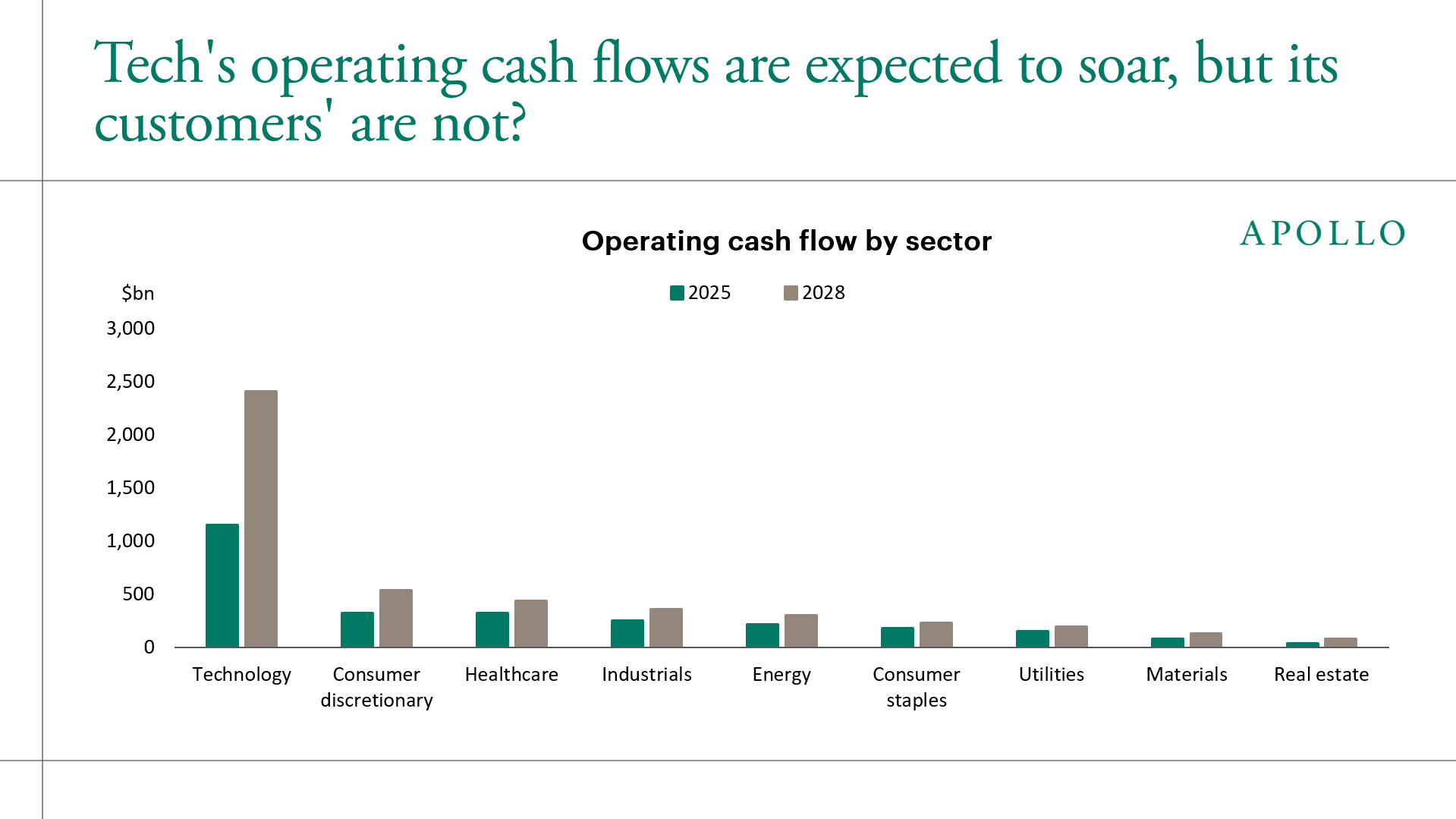
Anyway, I’ll leave you with a chart from Torsten Slok, Chief Economist at Apollo, and a very reasonable question: if all of these tech companies are expecting record earnings over the next few years, where exactly will the cash come from?
The analysts covering tech expect the sector's operating cash flow to more than double to roughly $2.4 trillion by 2028, an increase of over $1.2 trillion, see chart below. Meanwhile, the analysts covering the other sectors in the S&P 500, which are tech's customers, expect those companies to add much less operating cash flow.
In other words, the tech silo is betting on a future in which demand for AI and tech services explodes, while the silos covering the companies that would pay for those services see a much more modest outlook. Both cannot be right at the same time.
The bottom line is that either tech's customers will generate a lot more cash than their analysts expect, or tech's cash flow forecasts are too optimistic, which raises the question of who exactly will be writing all those checks to buy AI services.
The fact we can’t cleanly answer this question as hundreds of billions of dollars get sunk into AI data centers may be the most glaring miss in the history of finance.
If you liked this piece, you should subscribe to my premium newsletter. It’s $70 a year, $18 a quarter, or $7 a month, and in return you get a weekly newsletter that’s usually anywhere from 10,000 to 18,000 words and provides vast, detailed analyses of the biggest events and companies in the AI bubble.
If you want to get in touch — and especially if you have any juicy information about Anthropic, OpenAI, or any other companies in the AI bubble — hit me up on Signal at ezitron.76. I’m also on IB on The Terminal.